
Used Oil Recycling Service — From Fryer to Renewable Fuel
Turn your kitchen waste oil into verified carbon offsets with full lifecycle recycling, ESG-ready impact reports, and sustainability documentation. Every gallon your operation produces becomes renewable fuel instead of landfill waste.
Used Oil Recycling Service — From Fryer to Renewable Fuel
Turn your kitchen waste oil into verified carbon offsets with full lifecycle recycling, ESG-ready impact reports, and sustainability documentation. Every gallon your operation produces becomes renewable fuel instead of landfill waste.
A used oil recycling service collects spent cooking oil from commercial kitchens and processes it into biodiesel or renewable diesel through licensed rendering facilities. Each gallon diverted from landfill avoids approximately 18 pounds of CO2 emissions. Participating restaurants receive documented carbon offset data, sustainability certifications, and ESG-ready impact reports quantifying their environmental contribution.
Most Restaurants Have No Idea Where Their Used Oil Actually Goes
Sustainability-minded operators invest in compostable packaging, LED lighting, water-saving fixtures, and locally sourced ingredients — then hand hundreds of gallons of used cooking oil to a hauler who provides zero transparency about what happens next. For restaurants with genuine environmental commitments, corporate dining programs with ESG mandates, or B-Corp certified businesses building their annual impact reports, the gap between intention and documentation is a real problem. You cannot report a carbon offset you cannot verify. You cannot include recycling data in a GRI disclosure if your hauler gives you nothing more than a pickup receipt with a date on it.
The environmental impact of proper cooking oil recycling is substantial and quantifiable. According to the National Renewable Energy Laboratory, biodiesel produced from used cooking oil reduces lifecycle greenhouse gas emissions by 74 percent compared to petroleum diesel. The EPA Renewable Fuel Standard recognizes used cooking oil as a qualified feedstock precisely because of this documented carbon benefit. Yet the vast majority of restaurant operators — even those committed to sustainability — lack access to the data that proves their oil actually reached a licensed recycling facility and was converted into renewable fuel. Without that chain of custody documentation, the environmental benefit exists in theory but cannot be claimed in practice.
Closing this gap requires more than a recycling promise on a hauler website. It requires metered volume tracking on every pickup, digital chain of custody from kitchen to rendering facility, verified destination at an EPA-approved pathway processor, and quarterly impact reports that translate gallons collected into tons of CO2 offset. When these systems are in place, your used cooking oil becomes a measurable, reportable, and verifiable component of your organization environmental strategy — not just waste leaving through the back door.
2.4M+
gallons recycled
6,800+
tons CO₂ offset
100%
diversion from landfill
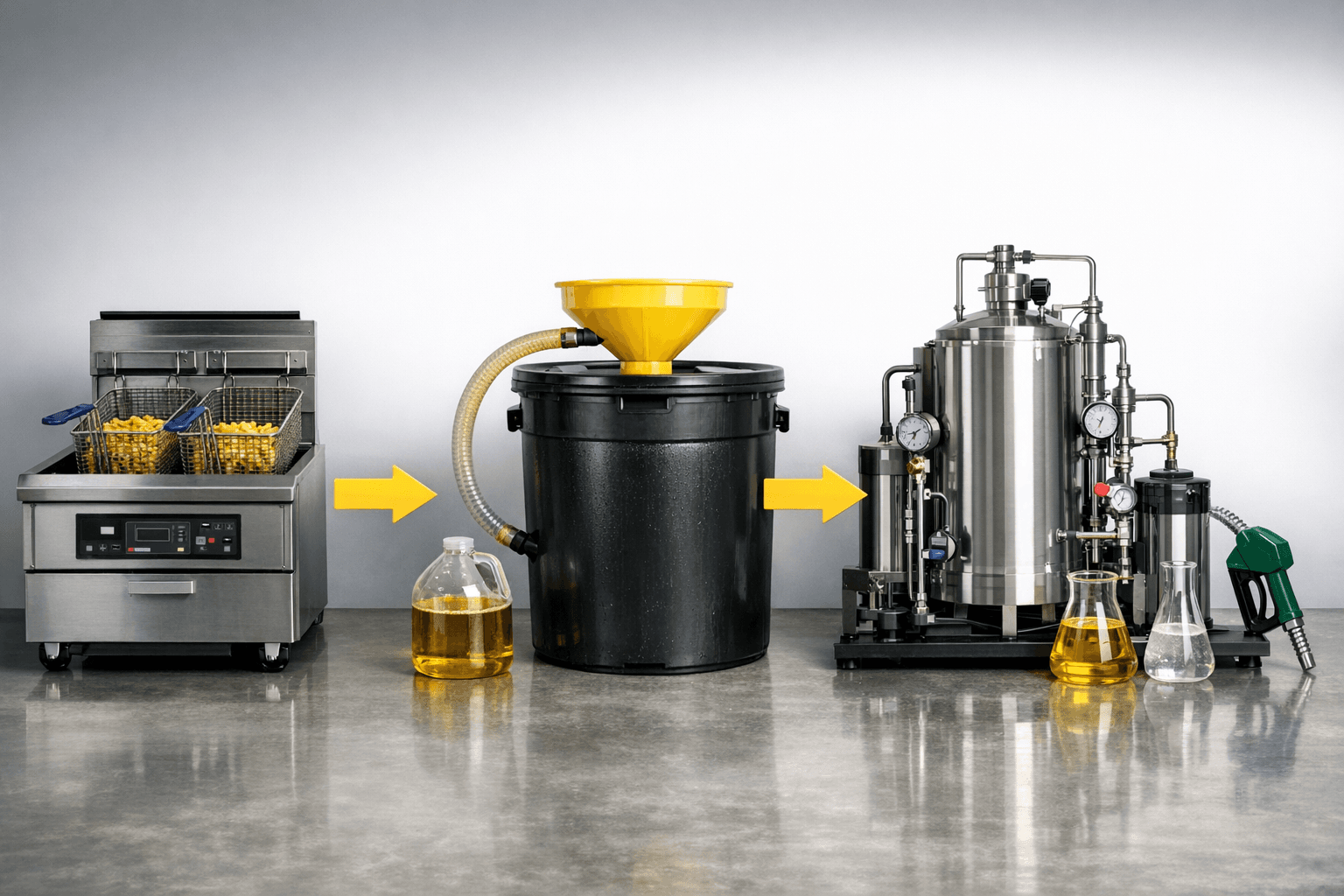
The Recycling Journey — Fryer to Biodiesel
Understanding what happens to your used cooking oil after pickup is essential for any operation that wants to claim environmental benefits with integrity. Here is the complete lifecycle. First, our driver arrives on schedule, connects a pump line to your sealed collection container, and transfers the oil into a metered compartment on the truck. The onboard meter records the exact volume to the tenth of a gallon. A digital manifest is generated immediately with the volume, date, driver credentials, and the licensed destination facility. From there, the oil is transported to a CDFA-licensed rendering facility where it undergoes quality testing for free fatty acid content, moisture, and impurities. The facility heats the oil to evaporate water, filters it to remove food particles, and produces a clean feedstock that meets biodiesel production specifications. This feedstock is then sold to a biodiesel or renewable diesel producer who converts it into transportation fuel through a process called transesterification. The resulting fuel follows an EPA-approved pathway under the Renewable Fuel Standard, generating Renewable Identification Numbers that verify the environmental benefit of each gallon produced.
- Metered pickup records exact volume on every collection
- Oil transported to CDFA-licensed rendering facility
- Quality testing, moisture removal, and contaminant filtration
- Clean feedstock converted to biodiesel or renewable diesel
- EPA-approved pathway generates verified Renewable Identification Numbers
Carbon Offset Quantification and ESG Reporting
Every gallon of used cooking oil that enters the renewable fuel supply chain instead of a landfill produces a measurable carbon offset. The National Renewable Energy Laboratory has documented that biodiesel from used cooking oil reduces lifecycle greenhouse gas emissions by 74 percent compared to petroleum diesel — a figure validated through decades of lifecycle analysis and recognized by the EPA under the Renewable Fuel Standard program. We translate this science into actionable data for your organization. Your quarterly impact report includes total gallons collected, equivalent metric tons of CO2 avoided, petroleum diesel gallons displaced, and a chain of custody summary confirming that your oil reached a licensed recycling facility. These reports are formatted for direct inclusion in CDP climate disclosures, Global Reporting Initiative sustainability reports, Scope 3 emissions inventories, and corporate annual sustainability statements. For operations pursuing or maintaining B-Corp certification, our documentation provides the verifiable environmental impact data that the B Impact Assessment requires in the Environment section.
- Quarterly impact reports with CO2 offset quantification
- Formatted for CDP, GRI, and Scope 3 emissions disclosures
- Chain of custody documentation from kitchen to recycler
- B-Corp certification compatible environmental impact data
- Petroleum diesel displacement metrics for annual reporting

Sustainability Certifications and Verification
Claims without verification are just marketing. Our recycling program provides the documentation infrastructure that turns your cooking oil disposal into a credible sustainability initiative. Every gallon is tracked from the moment it leaves your kitchen to the moment it enters a licensed processing facility, and the chain of custody record is available in your dashboard at all times. For operations pursuing Leadership in Energy and Environmental Design certifications, our waste diversion documentation supports LEED credits under the Materials and Resources category. For restaurant groups building sustainability programs around the Green Restaurant Association framework, our recycling verification provides documented proof of responsible waste management practices. Corporate dining operations managed by contract food service companies can feed our impact data directly into their parent organization sustainability reporting without manual data collection or estimation. The key distinction is that every number we report is measured — metered at the truck, weighed at the facility, and verified through the rendering process — not estimated or extrapolated from industry averages.
- Metered and verified data — never estimated or extrapolated
- LEED Materials and Resources credit documentation support
- Green Restaurant Association waste diversion verification
- Corporate dining integration with parent company ESG systems
- Full audit trail available in your dashboard at all times
Environmental Impact Beyond Carbon
The environmental benefits of proper cooking oil recycling extend well beyond carbon offset numbers. When used cooking oil reaches a landfill, it undergoes anaerobic decomposition that produces methane — a greenhouse gas with 80 times the warming potential of carbon dioxide over a twenty-year period. Oil that enters storm drains or waterways creates surface films that block oxygen transfer, suffocating aquatic life and triggering costly remediation efforts by municipal water agencies. Improperly disposed grease that reaches wastewater treatment plants causes fatberg formations that block sewer infrastructure and cost municipalities millions in maintenance. By recycling every gallon through a licensed facility, your operation avoids all of these downstream environmental harms while simultaneously producing renewable fuel that displaces petroleum consumption. Our 100 percent landfill diversion guarantee means that no oil collected from your operation ever reaches a landfill, storm drain, or wastewater system. Every gallon enters the renewable fuel supply chain. That commitment is documented, trackable, and auditable through your compliance dashboard.
- Prevents methane generation from landfill decomposition
- Eliminates storm drain and waterway contamination risk
- Avoids fatberg formations in municipal sewer infrastructure
- Displaces petroleum diesel consumption with renewable fuel
- 100% landfill diversion guarantee — documented and auditable

Who This Is For
Eco-Conscious Restaurants
Independent and small-chain restaurants with genuine sustainability commitments that want verified recycling data, not just a hauler who says they recycle.
Corporate Dining With ESG Mandates
Corporate cafeterias and executive dining operations managed by Aramark, Sodexo, or Compass Group that need quarterly impact data for parent company sustainability reporting.
B-Corp Certified Businesses
Certified B Corporations that require verifiable environmental impact data for their B Impact Assessment and annual recertification process.
Green-Certified Hotels
Hotels pursuing or maintaining LEED, Green Key, or Green Seal certifications that need documented waste diversion rates and environmental compliance records.
Farm-to-Table Restaurants
Restaurants built around sustainability narratives that want their back-of-house waste management to match the environmental standards of their front-of-house sourcing philosophy.
Organic Grocery Delis
Whole Foods, Sprouts, and independent organic grocery prepared food departments that need recycling documentation aligned with their corporate sustainability programs.
Recycling vs. Landfill Disposal
Landfill Disposal
Proper Recycling
What's Included
Everything you need — nothing you don't.
- Free collection container with sealed, anti-theft design
- Scheduled pickup on a consistent, reliable day every week
- Metered volume tracking on every collection visit
- Digital CDFA-compliant manifest after every pickup
- Online dashboard with full recycling history and documentation
- Quarterly ESG impact report with CO2 offset quantification
- Chain of custody documentation from kitchen to recycler
- B-Corp, LEED, and GRA certification support documentation
- Seven-year digital record retention with instant export
- Container replacement or upgrade at no charge
- 100% landfill diversion guarantee — documented and auditable
- No contracts, no fees, no equipment rental
How It Works
Three steps. Five minutes. Done.
Request a Quote
Fill out a 30-second form or call us. No credit card, no commitment.
We Show Up On Time
Our uniformed driver arrives in a branded truck within your scheduled window. Every time.
Stay Compliant Automatically
Get digital manifests, pickup confirmations, and compliance records — all in your dashboard.
Frequently Asked Questions
The carbon math is well-established through lifecycle analysis conducted by the National Renewable Energy Laboratory and validated by the EPA under the Renewable Fuel Standard program. One gallon of used cooking oil, when converted to biodiesel, displaces approximately one gallon of petroleum diesel and avoids roughly 18 pounds of CO2 equivalent emissions. This figure accounts for the full lifecycle — collection, transport, processing, and combustion — and reflects the 74 percent greenhouse gas reduction that NREL documented in its biodiesel lifecycle analysis available at docs.nrel.gov/docs/fy03osti/31460.pdf. For a restaurant producing 50 gallons of used oil per week, that translates to approximately 24 metric tons of CO2 avoided annually. We calculate your specific offset in every quarterly impact report using your actual metered collection volumes, not industry estimates.
Yes. Our quarterly impact reports are specifically designed for inclusion in corporate sustainability disclosures. Each report includes total gallons collected (metered, not estimated), equivalent metric tons of CO2 avoided, petroleum diesel gallons displaced, confirmation of licensed recycling facility destination, and chain of custody summary. The data format aligns with CDP Climate Change questionnaire requirements, Global Reporting Initiative waste and emissions standards, and Scope 3 Category 5 (Waste Generated in Operations) methodology. For multi-location operations, we provide both facility-level and portfolio-level aggregation so your sustainability team can report at whatever granularity your disclosure framework requires. Several of our corporate dining clients include our impact data directly in their parent company annual sustainability statements and investor presentations.
The EPA Renewable Fuel Standard program maintains a list of approved feedstock-to-fuel pathways at epa.gov/renewable-fuel-standard/approved-pathways-renewable-fuel. Used cooking oil qualifies as a feedstock for both biodiesel (D4 RIN category) and renewable diesel (D4 RIN category) because its lifecycle greenhouse gas emissions meet the 50 percent reduction threshold required for biomass-based diesel. The oil must be collected from commercial food preparation operations, transported by licensed haulers, and processed at registered facilities that meet EPA quality and documentation standards. The resulting fuel generates Renewable Identification Numbers that verify the environmental benefit and track each gallon through the supply chain. Our collection and documentation systems are specifically designed to maintain the chain of custody that EPA-registered producers require when sourcing used cooking oil feedstock.
Verification happens at multiple points in the chain of custody. First, every pickup generates a digital manifest with the exact volume, date, driver credentials, and the specific licensed rendering facility designated as the destination. Second, our GPS tracking system logs the vehicle route from your location to the delivery point, creating a geographic record that matches the manifest. Third, the rendering facility issues a receiving ticket when the load arrives, confirming the volume delivered. Fourth, the rendering facility holds a current CDFA license that requires them to maintain processing records subject to state inspection. All of this documentation is accessible through your compliance dashboard. If you ever want to independently verify our rendering facility license status, the CDFA maintains a public registry at cdfa.ca.gov/ahfss/MPES/Rendering/RenderingFAQ.html where you can confirm licensing and compliance status.
Proper cooking oil recycling contributes to both frameworks. For LEED certification, documented waste diversion supports credits under the Materials and Resources category, specifically MR Credit: Solid Waste Management. Our recycling verification showing 100 percent diversion from landfill provides the documentation LEED assessors require. For the Green Restaurant Association certification framework, cooking oil recycling falls under the Waste category and contributes points toward your overall GRA score. Our chain of custody documentation, metered volume records, and destination verification provide the specific evidence that GRA auditors evaluate during the certification process. We also provide documentation compatible with Green Seal, Green Key, and the National Restaurant Association Conserve sustainability program. Your account manager can help format the data for whichever certification framework your operation is pursuing.
Both fuels are produced from used cooking oil but through different processes with different end products. Biodiesel is made through transesterification — a chemical process that reacts the oil with methanol to produce fatty acid methyl esters. It is typically blended with petroleum diesel at concentrations of 5 to 20 percent (B5 to B20) and requires engine compatibility consideration at higher blends. Renewable diesel, also called hydrotreated vegetable oil, is produced through hydroprocessing — using hydrogen to remove oxygen from the oil molecules, creating a fuel that is chemically identical to petroleum diesel. Renewable diesel can be used as a 100 percent drop-in replacement in any diesel engine without modification or blending. Both fuels qualify under the EPA Renewable Fuel Standard program at epa.gov/renewable-fuel-standard-program and generate Renewable Identification Numbers. The lifecycle carbon reduction is comparable for both pathways, and your used cooking oil can become either fuel depending on which producer purchases the feedstock from the rendering facility.
What Our Clients Say
“The quarterly impact reports transformed our sustainability narrative. We went from telling customers we recycle our oil to showing them exactly how many tons of CO2 our restaurants offset last quarter. The data goes straight into our annual impact report without any manual calculation.”

Rachel Torres
Sustainability Director, Verdant Restaurant Group
Costa Mesa
“Our ownership group requires ESG data from every property. The recycling program gives us property-level and portfolio-level carbon offset numbers formatted exactly how our sustainability consultants need them for CDP reporting. No other hauler even came close to offering this.”

James Whitfield
VP of Facilities, Pacific Coast Hotel Management
San Diego
“As a B-Corp certified restaurant, we need verifiable environmental data for every part of our operation. The chain of custody documentation and carbon offset quantification made our recertification audit seamless. Our customers care about this and so do we.”

Mei-Lin Huang
Owner, Bamboo Leaf Organic Kitchen
Laguna Beach
Related Solutions
Biodiesel Feedstock Collection
Reliable UCO feedstock supply for biodiesel producers with quality guarantees, volume aggregation, and RIN-qualified documentation.
Learn moreYellow Grease Recycling
Sealed container systems, GPS tracking, and theft prevention for high-volume operations producing yellow grease.
Learn moreFree Used Cooking Oil Pickup
Scheduled collection for restaurants, food trucks, and commercial kitchens with CDFA-compliant documentation and zero cost.
Learn moreLast updated April 10, 2026
Start Measuring Your Environmental Impact Today
Free pickup, verified recycling, quarterly ESG reports. Turn your used cooking oil into a documented sustainability win.