California has some of the most specific regulations around used cooking oil disposal in the country. For restaurant owners and food service operators, that means your disposal method isn't just an operational preference — it's a compliance matter. Get it wrong and you're looking at fines, inspection failures, and potential liability.
This guide breaks down the legal landscape, what options are actually available to you, and the disposal mistakes that get Southern California restaurants into trouble every year.
Why California Regulates Used Cooking Oil So Closely
Used cooking oil (UCO) has significant commodity value. It's a primary feedstock for biodiesel and renewable diesel production, and California's Low Carbon Fuel Standard (LCFS) makes that value even higher by incentivizing renewable fuel production. That value, ironically, is also what creates a theft and fraud problem.
Grease theft — where unlicensed operators steal oil from restaurant containers or pose as legitimate haulers — costs the industry tens of millions of dollars annually. California has responded with a regulatory framework through the California Department of Food and Agriculture (CDFA) that requires all UCO haulers to be registered and all collections to be documented with proper manifests.
For restaurants, this creates a responsibility: you must use licensed haulers and maintain documentation. Ignorance of your hauler's status is not a legal defense.
CDFA Regulations: What Restaurants Need to Know
The California Food and Agricultural Code regulates inedible kitchen grease (IKG), which includes used cooking oil. Key points:
Licensed haulers only. Any person or company transporting your used cooking oil must hold a valid CDFA Inedible Kitchen Grease Hauler registration. You can verify a hauler's status through the CDFA's online registry. This is not optional — using an unregistered hauler exposes your business to regulatory action.
Manifests are mandatory. Every pickup must be accompanied by a manifest that includes the date of collection, the hauler's registration number, the volume collected, your facility's address, and the destination facility. You are required to retain these manifests. California health inspectors increasingly ask for them during routine inspections.
Rendering facilities must be permitted. The facility that ultimately processes your oil must also be permitted by CDFA. Your hauler should be delivering to a licensed rendering or biodiesel processing facility — not to an unknown location.
Documentation retention. Keep your manifests and collection records for a minimum of three years. Store them somewhere you can retrieve them quickly — a drawer near the manager's station or a digital file in your management software.
Legal Used Cooking Oil Disposal Options in California
Option 1: Scheduled Pickup by a Licensed UCO Hauler
This is the most common and most practical option for restaurants. A CDFA-registered hauler provides a container, collects your oil on a regular schedule, and handles all downstream processing and documentation.
For most Southern California restaurants, this service is free because your oil has commodity value that offsets the hauler's collection costs. Kitchen Oil Recycling's free used cooking oil pickup service covers Orange County, LA, and San Diego, and handles all manifest documentation on your behalf.
Option 2: Bulk Pickup for High-Volume Operations
If you operate a large commissary kitchen, a food manufacturing facility, or a multi-location restaurant group, you may generate enough volume to warrant a different arrangement — typically a large-capacity container and a dedicated pickup schedule. Bulk cooking oil disposal and recycling arrangements often come with more favorable revenue sharing terms, because the economics work better at scale.
Option 3: Municipal Drop-Off Programs
Some California counties and municipalities operate drop-off programs for used cooking oil, primarily targeting residential generators. These programs are not well-suited to commercial volumes and are generally inappropriate for any restaurant generating more than a few gallons per week. They exist as a last resort for micro-operations or as a gap solution when switching providers.
Option 4: On-Site Filtration and Extended Use
Some operations use commercial oil filtration systems to extend the usable life of their fryer oil, reducing the volume of UCO generated. This doesn't eliminate your disposal need — it just reduces frequency. Filtration systems can improve oil quality and food quality simultaneously. This is a legitimate operational strategy, not a disposal method by itself.
What You Cannot Do: Illegal Disposal Methods
Pouring Oil Down the Drain
This is the most common violation, and also the most consequential. Cooking oil poured down a drain contributes to FOG (fats, oils, and grease) buildup in sewer lines. California municipalities have FOG ordinances specifically targeting commercial kitchens as the primary source of sewer blockages and overflows.
Penalties range from mandatory grease trap installation (which can cost $5,000–$30,000+ depending on your setup) to direct fines, to being named as a responsible party in a sewer overflow remediation action. The Environmental Protection Agency has federal authority over sewer overflow incidents — this can escalate beyond a local citation.
Dumping in Trash or Dumpster
Liquid waste cannot be disposed of in standard solid waste containers. Many municipalities explicitly prohibit dumping liquid grease in dumpsters, and waste haulers may refuse collection of bins contaminated with oil. If liquid waste causes damage to a sanitation vehicle or facility, you may be billed for the damage.
Stockpiling Without Proper Containment
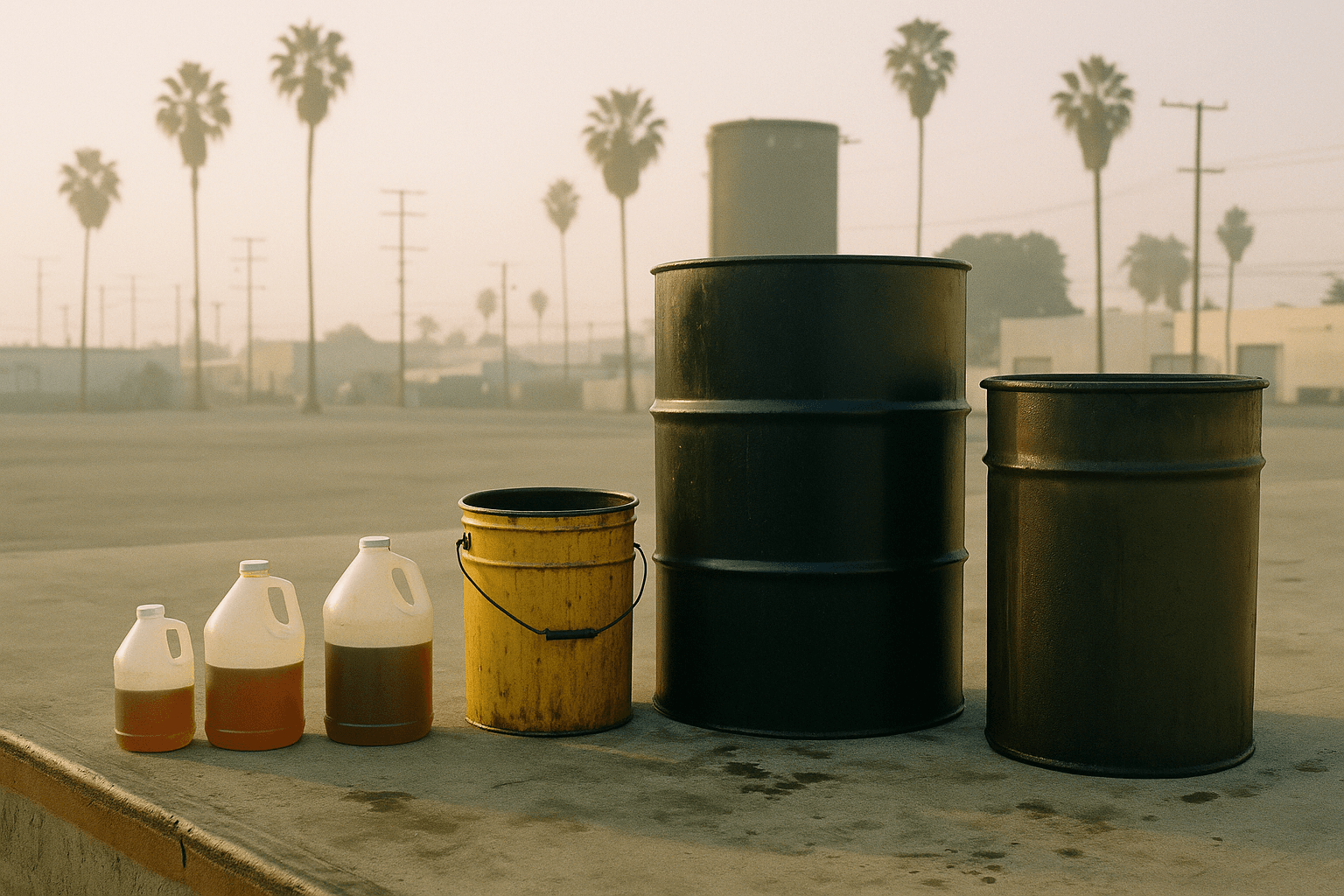
Some operators attempt to avoid the issue by stockpiling old fryer oil in the back of house — in buckets, cardboard boxes, or non-sealed containers. This creates fire hazards, pest attraction, and health code violations. California health inspectors look specifically for improperly stored waste products.
Using Unlicensed Haulers
This one gets operators into trouble most often. Unlicensed haulers — often operating door-to-door without a registered business — may offer to take your oil for free or even promise a payment. The problem is that many of these operations either resell the oil to legitimate processors while pocketing the value (theft from your account) or dispose of it illegally. When CDFA traces improper disposal back to the source restaurant, the restaurant owner may bear liability.
If someone shows up unsolicited offering to take your grease, ask for their CDFA registration number and verify it before letting them touch anything.
The Grease Trap Connection
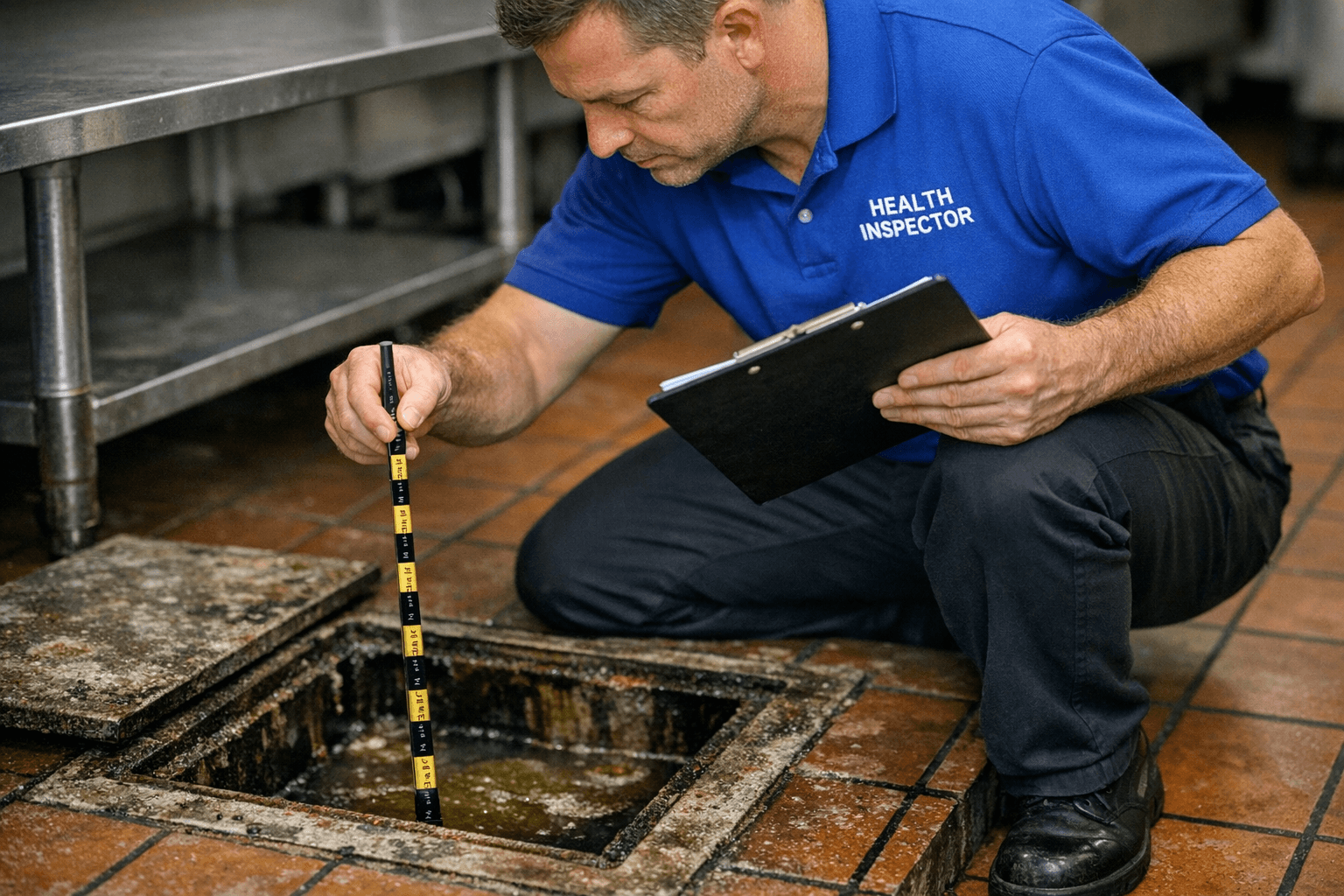
Improper cooking oil disposal often intersects with grease trap compliance. Your grease trap (also called a grease interceptor) is designed to capture FOG before it enters the sewer system. If you're not managing your cooking oil properly, your grease trap will fill up faster — and an overflowing or undersized trap is a direct code violation.
Many Southern California municipalities require proof of regular grease trap cleaning as part of permit renewal. Kitchen Oil Recycling's grease trap cleaning service keeps that part of your compliance picture clean as well — and we can coordinate scheduling to pair UCO pickup with trap service.
How to Verify Your Current Provider Is Compliant
If you already have a UCO pickup provider, confirm the following:
- CDFA registration number — Ask for it. Verify it on the CDFA website. This takes five minutes.
- Manifests on file — Do you have signed manifests from every pickup in the last 12 months? If not, ask your provider for copies.
- Container condition — Is your container sealed, lockable, and in good repair? A rusted or leaking container is a liability.
- Pickup consistency — Is your provider showing up on schedule? Sporadic or missed pickups are a red flag.
If you're uncertain about your current situation or looking to make a change, our team at Kitchen Oil Recycling can review your setup and identify any compliance gaps.
Setting Up Compliant Disposal From Scratch
For operators setting up a new location or formalizing a previously informal arrangement:
- Estimate your weekly fryer oil usage. This determines container size and pickup frequency.
- Contact a CDFA-registered hauler and verify their license.
- Have a container placed before you open or before your current arrangement lapses.
- Brief kitchen staff on proper oil handling: cool before transfer, no water contamination, keep the container locked.
- File your first manifests and start a records folder.
Kitchen Oil Recycling handles steps 2 through 5 as part of our standard onboarding. For restaurants in Orange County, Los Angeles, and San Diego, we can typically have a container placed within a week of your first inquiry.
California's regulatory environment around cooking oil disposal is detailed, but compliance isn't complicated if you're working with the right partner. Use a licensed hauler, keep your manifests, and maintain your grease trap — and this becomes a non-issue for your operation.