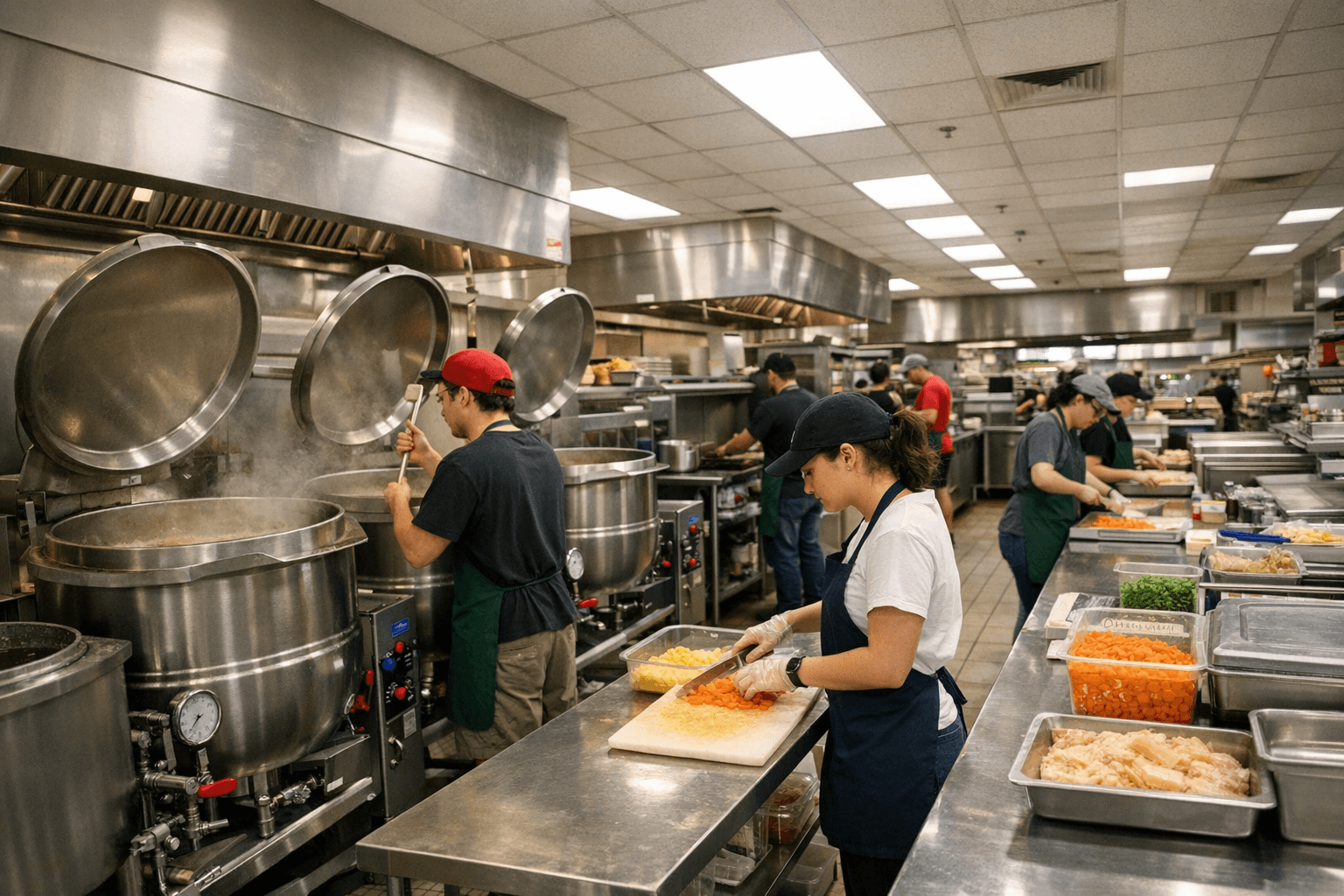
Grease Pickup Built for Campus Dining Operations
Free, scheduled cooking oil collection designed for university dining halls, student food courts, campus catering kitchens, and athletic event concessions across Southern California. Procurement-compliant proposals, sustainability data for campus reporting, and academic-calendar scheduling that adjusts for breaks and peak enrollment periods.
Grease Pickup Built for Campus Dining Operations
Free, scheduled cooking oil collection designed for university dining halls, student food courts, campus catering kitchens, and athletic event concessions across Southern California. Procurement-compliant proposals, sustainability data for campus reporting, and academic-calendar scheduling that adjusts for breaks and peak enrollment periods.
Quick Answer
University dining grease pickup is a free, scheduled service that collects used cooking oil from campus dining halls, food courts, and catering kitchens. A CDFA-licensed driver arrives on a fixed schedule, services containers at each dining facility, generates digital manifests, and transports oil for biodiesel recycling. Service covers UC, Cal State, and community college campuses across Southern California.
Campus Dining Operations Run at Institutional Scale With Institutional Red Tape
A mid-size California university operates three to five dining halls, a student food court with a dozen vendor concepts, a catering kitchen, and athletic event concessions — all producing used cooking oil that must be collected, documented, and disposed of in compliance with California law. The CDFA Inedible Kitchen Grease program under CCR Title 3 Section 1180 does not waive requirements for state institutions, and campus kitchens face the same manifest and licensed-transporter obligations as any commercial restaurant. California Health and Safety Code Section 114201 requires functioning grease traps and interceptors in every food facility leginfo.legislature.ca.gov, and county FOG programs in Los Angeles and Orange County apply to campus properties within their jurisdictions. But unlike a standalone restaurant that can switch haulers in a phone call, universities must navigate procurement processes, competitive bidding requirements, and multi-year contract structures that make changing grease service providers a months-long ordeal. For details on how FOG violations are assessed at institutional facilities, review our analysis at /blog/california-fog-violations-penalties-restaurants.
The academic calendar creates a scheduling problem that generic haulers do not understand or accommodate. Dining hall output drops by 60 to 80 percent during winter break, spring break, and summer session — but your hauler keeps showing up on the same weekly schedule, charging for trips where they pump 10 gallons from a container designed for 200. Then enrollment surges in September, homecoming weekends spike catering volume, and your hauler cannot add capacity fast enough to prevent overflows at the main dining hall. The LA County 25-percent grease trap rule applies to campus kitchens regardless of whether students are on break or not, and our guide at /blog/la-county-25-percent-grease-trap-rule explains how inspectors evaluate institutional food service operations during these variable-volume periods.
University sustainability mandates add another dimension. UC system campuses are committed to carbon neutrality, Cal State schools have their own sustainability frameworks, and community colleges face increasing pressure to demonstrate environmental responsibility. Your grease service should be a contributor to those goals, not just a compliance checkbox. Used cooking oil recycled into biodiesel directly reduces campus carbon footprint, and documented diversion data belongs in your annual sustainability report. But most haulers provide nothing beyond a pickup receipt — no diversion metrics, no carbon offset calculations, no data formatted for the reporting frameworks campus sustainability offices actually use. Our /tools/compliance-checker can help your procurement team verify that a prospective grease hauler meets both regulatory and sustainability requirements before issuing an RFP.
45+
campus dining operations served
99.5%
on-time pickup rate
120K gal
campus oil diverted to biodiesel annually
Multi-Facility Campus Coverage Under One Agreement
Universities are not single-location operations, and your grease service should not treat them that way. We map every dining facility on your campus during onboarding — main dining halls, satellite cafes, student union food courts, catering prep kitchens, and athletic concession stands. Each facility receives a container sized for its production volume, and pickup schedules are individualized per building. Your dining services director gets one dashboard, one invoice reconciliation point, and one account manager for the entire campus — not a separate vendor relationship for each building.
- Individual containers and pickup schedules for every dining facility on campus
- Consolidated dashboard and reporting for dining services administration
- Single account manager and procurement-compliant invoicing for the entire campus
- Per-facility volume tracking for internal cost allocation across dining budgets
- Coverage includes dining halls, food courts, catering kitchens, and concession stands
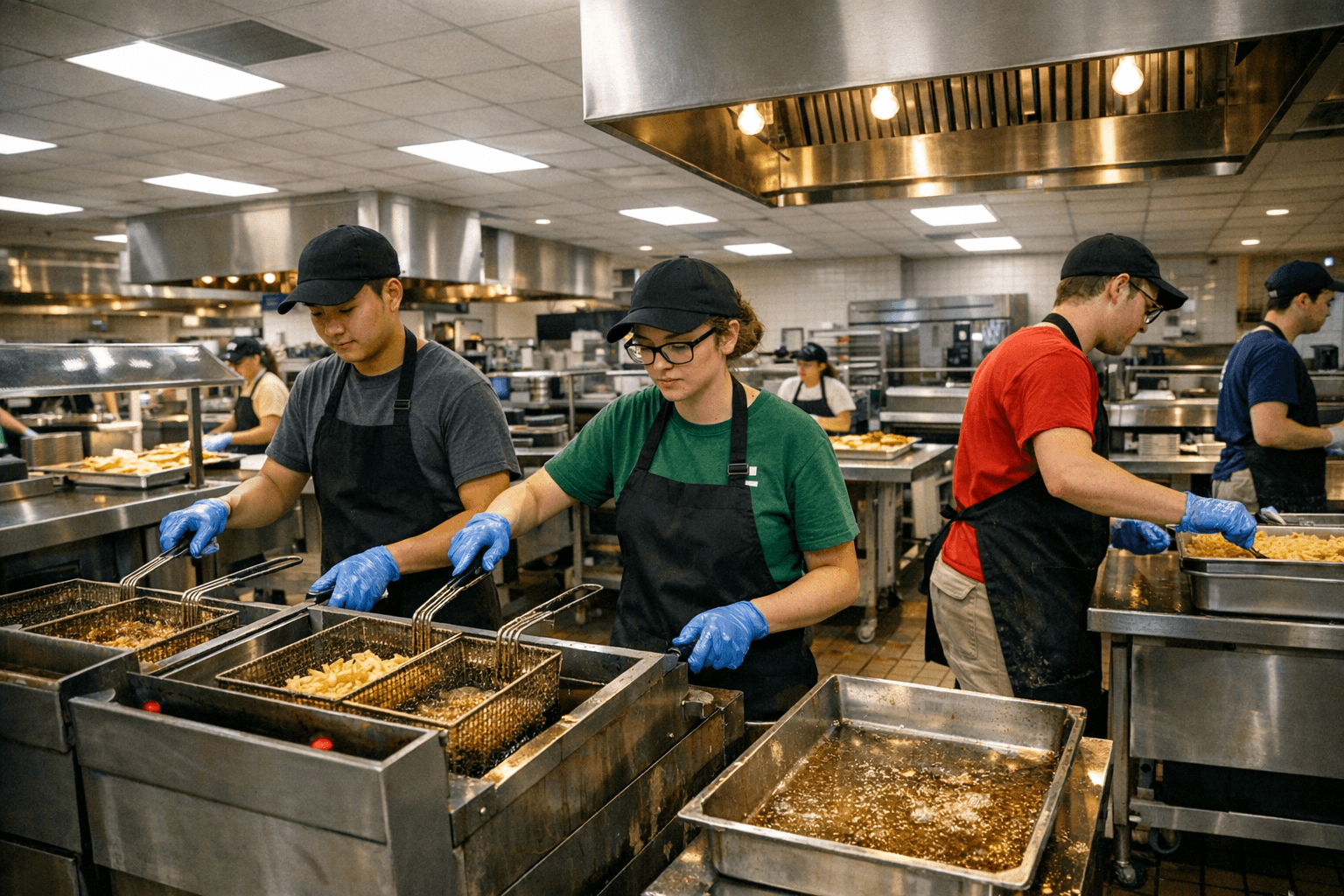
Academic Calendar Scheduling That Actually Adapts
Your campus does not produce the same oil volume in August move-in week as it does during winter break. We build your academic calendar into our scheduling system and adjust pickup frequency automatically for fall start, winter break, spring break, summer session, commencement weekend, and every enrollment fluctuation in between. When homecoming or a campus-wide event spikes catering volume, we pre-schedule additional pickups based on your events calendar. You never pay for unnecessary trips during low-volume periods, and you never face an overflow during the first week of fall semester.
- Academic calendar integrated into scheduling — automatic adjustments for breaks and sessions
- Frequency increases during fall start, homecoming, and commencement weekends
- Reduced service during winter break, spring break, and summer session
- Pre-scheduled surge pickups for campus events and catering-heavy weekends
- No charge for schedule adjustments — service adapts to your actual academic rhythm
Sustainability Data for Campus Reporting
UC campuses pursuing carbon neutrality and Cal State schools with sustainability mandates need more than a pickup receipt — they need diversion data formatted for annual sustainability reports, carbon offset calculations for Scope 3 emissions reporting, and documentation that demonstrates responsible waste management practices. Our dashboard provides total gallons diverted, equivalent CO2 offset from biodiesel conversion, and exportable data compatible with AASHE STARS, Second Nature, and other higher education sustainability reporting frameworks. Your campus sustainability office gets data they can actually use, not a stack of paper manifests they have to interpret.
- Total gallons diverted and equivalent CO2 offset calculated per semester and fiscal year
- Data formatted for AASHE STARS and Second Nature sustainability reporting frameworks
- Exportable reports for annual campus sustainability publications and board presentations
- Per-facility diversion tracking for departmental sustainability goals
- Biodiesel conversion documentation supporting Scope 3 emissions reduction claims

Procurement-Friendly Service With No Bidding Headaches
University procurement offices need proposals that meet institutional purchasing requirements, and our service is structured to simplify that process. Because the service is free — no fees, no contracts — it often falls below competitive bidding thresholds, allowing dining services to onboard without a full RFP cycle. For campuses that do require formal procurement, we provide complete proposal packages including CDFA licensing documentation, insurance certificates, sustainability credentials, references from other California campus accounts, and pricing structures that procurement officers can evaluate against alternatives. Our /services/grease-trap-cleaning program can be bundled into the same proposal for campuses that need integrated grease management.
- Free service often falls below competitive bidding thresholds for faster onboarding
- Complete proposal packages for formal RFP processes when required
- CDFA licensing, insurance, and sustainability credentials included in all proposals
- References from UC, Cal State, and community college campus accounts
- Multi-year agreement options that align with university fiscal year and budget cycles
Campus Dining Operations We Serve Across Southern California
UC System Dining Services
University of California campus dining halls and food service operations with carbon neutrality commitments, high enrollment volumes, and institutional procurement requirements.
Cal State Campus Kitchens
California State University dining facilities with sustainability mandates, multi-building campus layouts, and budget-conscious dining service administration.
Community College Cafeterias
Community college food service operations with smaller kitchen footprints, tighter budgets, and simpler procurement processes that benefit from free collection service.
Student Food Court Operations
Multi-vendor student union food courts with diverse cuisine concepts generating variable oil types and volumes from shared kitchen infrastructure.
Campus Catering & Event Kitchens
University catering operations serving faculty events, donor receptions, commencement banquets, and athletic hospitality with seasonal volume spikes.
Athletic Venue Concessions
Stadium and arena concession stands on campus producing event-day grease volumes that spike during football season, basketball season, and tournament weekends.
Campus-Ready Grease Service vs. Commercial Restaurant Haulers
Multi-facility coordination
Cost to university
Academic calendar
Sustainability reporting
Procurement support
CDFA compliance
What's Included
Everything you need — nothing you don’t.
- Free collection containers at every dining facility on your campus
- Academic-calendar-aware scheduling with automatic break and session adjustments
- CDFA-compliant digital manifests at per-facility and campus-wide levels
- Online dashboard with sustainability metrics, diversion data, and compliance reports
- Procurement-ready proposal packages for institutional purchasing processes
- Per-facility volume tracking for internal dining services budget allocation
- 24/7 emergency overflow and spill response at no additional charge
- No contracts required, no setup fees, no monthly charges, no hidden costs
- Dedicated account manager for campus-wide coordination
How It Works
Three steps. Five minutes. Done.
Request a Quote
Fill out a 30-second form or call us. No credit card, no commitment.
We Show Up On Time
Our uniformed driver arrives in a branded truck within your scheduled window. Every time.
Stay Compliant Automatically
Get digital manifests, pickup confirmations, and compliance records — all in your dashboard.
Frequently Asked Questions
University dining halls are classified as food service establishments and must comply with all California grease disposal regulations. The CDFA Inedible Kitchen Grease program cdfa.ca.gov/ahfss/MPES/Rendering/ requires licensed transporters and compliant manifests per CCR Title 3 Section 1180 for every pickup, regardless of whether the facility is privately or publicly operated. California Health and Safety Code Section 114201 leginfo.legislature.ca.gov/faces/codes_displaySection.xhtml?lawCode=HSC§ionNum=114201 requires functioning grease traps and interceptors in every campus kitchen. LA County FOG cleanla.lacounty.gov/fog/ and OC San FOG permits ocsan.gov/ocsan-permits/businessfog/ apply to campus facilities within their respective jurisdictions. UC and Cal State properties are not exempt from county FOG programs. Violations start at $1,000 per offense per facility.
Because our service is free — no fees and all equipment provided at no charge — it often falls below the dollar thresholds that trigger competitive bidding requirements at UC, Cal State, and community college campuses. The specific threshold varies by institution, but many campus procurement offices can onboard a zero-cost vendor through a simplified purchasing process rather than a full RFP cycle. For campuses that prefer or require formal procurement, we provide complete proposal packages with CDFA licensing, insurance certificates, sustainability credentials, campus references, and service-level documentation that procurement officers can evaluate through standard competitive review processes.
We integrate your full academic calendar — including fall start, winter break, spring break, summer sessions, finals weeks, commencement, and move-in weekends — into our scheduling system. Pickup frequency automatically scales to match enrollment-driven dining volume. During winter break when dining halls run at 20 percent capacity, we reduce to biweekly or monthly service. When fall semester starts and 30,000 students arrive on campus, we increase to multiple pickups per week at high-volume facilities. Schedule adjustments are automatic and there is no charge for increasing or decreasing frequency throughout the year.
Our dashboard provides total gallons of used cooking oil diverted from landfill, equivalent CO2 emissions offset through biodiesel conversion, and per-facility diversion metrics broken down by semester and fiscal year. Data exports are formatted to be compatible with AASHE STARS sustainability tracking, Second Nature reporting frameworks, and the campus-specific annual sustainability reports that UC and Cal State schools publish. Your campus sustainability office can pull this data directly from the dashboard without requesting it from our team. We also provide a narrative-ready summary of your campus oil diversion program that can be included in sustainability publications and board presentations.
Yes. During onboarding, we map every dining facility on your campus — main dining halls, satellite cafeterias, student union food courts, catering prep kitchens, faculty dining rooms, athletic concession stands, and any other food production points. Each facility receives a container sized for its individual output, and pickup schedules are tailored per building based on actual production volume and meal plan enrollment data. Your dining services administration sees all facilities on one consolidated dashboard with the ability to drill into per-facility volume, compliance status, and diversion metrics.
Student food courts typically house six to fifteen vendor concepts — burger stations, Asian cuisine, pizza, Mexican food, salad bars with fryers — all sharing common kitchen infrastructure. We install shared containers sized for the combined output of all vendors and set pickup frequency based on total food court production. For food courts where individual vendors are operated by different companies or campus dining subcontractors, we provide per-vendor volume estimates and documentation that allows your dining services team to allocate grease management responsibility fairly across operators.
What Our Clients Say
“We have four dining halls, a food court with eleven vendors, and a catering kitchen. Our previous hauler charged us year-round at the same rate even though summer enrollment is a quarter of fall. Now the service is free, it adjusts for our academic calendar automatically, and my sustainability coordinator has real diversion data for our annual report instead of estimates.”

Dr. Angela Reyes
Director of Dining Services, Cal State University Campus
Fullerton
“Procurement wanted to run a full RFP for grease service, which would have taken six months. Because the service is free and we are not paying anything, it went through simplified purchasing in three weeks. We had containers at both campus cafeterias within ten days of signing. The compliance documentation alone would have been worth paying for — getting it free is remarkable.”

David Park
Facilities Manager, Community College District
Irvine
“Our carbon neutrality commitment requires documenting every waste stream diversion on campus. The previous hauler gave us pickup receipts in a shoebox. Now I pull semester-level diversion data and CO2 offset calculations directly from the dashboard and drop them into our AASHE STARS submission. The data quality transformed our waste diversion reporting from an estimate to an auditable metric.”

Michelle Thompson
Campus Sustainability Officer, UC Research Campus
San Diego
Related Resources
Guides
Free Tools
- Grease Trap Calculator
Find your recommended pumping frequency
- Compliance Checker
Check if you meet California grease requirements
Related Solutions
Stadium & Arena Grease Pickup
High-volume grease collection for stadiums, arenas, and event venues with event-day surge scheduling and multi-concession coordination.
Learn moreCasino & Country Club Grease Pickup
Multi-outlet grease collection for casino and country club kitchens with banquet surge scheduling and discreet guest-experience-focused service.
Learn moreRestaurant Grease Pickup
Free, scheduled cooking oil collection for independent restaurants with CDFA-compliant manifests and reliable weekly service across Southern California.
Learn moreGet Free Campus Dining Grease Pickup — No Contract Required
Tell us about your campus dining facilities and academic calendar. We will confirm your pickup schedule within 2 hours and deliver containers within the week.