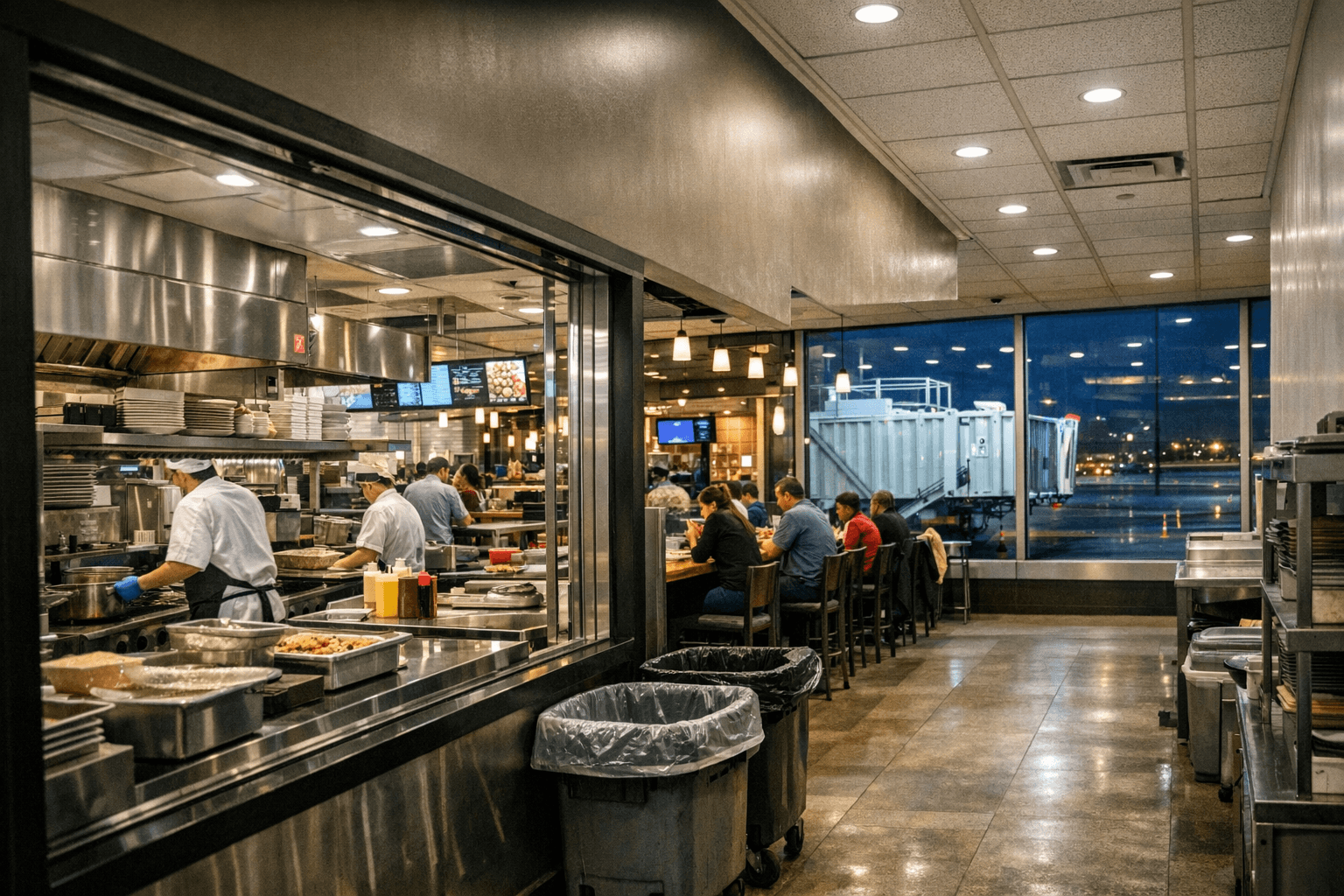
Airport Grease Pickup Built for Terminal and Flight Kitchen Operations
Security-cleared, CDFA-compliant cooking oil collection for airport terminal restaurants, airline catering facilities, and concession operators at LAX, John Wayne (SNA), San Diego International (SAN), and Long Beach (LGB). TSA-coordinated scheduling, airport authority vendor compliance, and zero disruption to passenger operations.
Airport Grease Pickup Built for Terminal and Flight Kitchen Operations
Security-cleared, CDFA-compliant cooking oil collection for airport terminal restaurants, airline catering facilities, and concession operators at LAX, John Wayne (SNA), San Diego International (SAN), and Long Beach (LGB). TSA-coordinated scheduling, airport authority vendor compliance, and zero disruption to passenger operations.
Quick Answer
Airport restaurant grease pickup is a free, security-cleared service that collects used cooking oil from terminal restaurants, airline flight kitchens, and airport concession operators. CDFA-licensed drivers with airport badging coordinate pickups through TSA-approved scheduling windows, generate digital manifests, and transport oil for biodiesel recycling. Service covers LAX, John Wayne SNA, San Diego SAN, and Long Beach LGB.
Airport Grease Operations Face Security, Scheduling, and Multi-Operator Complexity That No Standard Hauler Can Navigate
Airport food service operations exist inside one of the most regulated physical environments in the country. Every vendor entering an airport terminal or airside facility must clear security credentialing through the airport authority, maintain TSA-compliant identification, and operate within strictly defined vehicle routing and scheduling windows. A standard grease hauler cannot simply drive up to a terminal restaurant loading area — they need airport-issued badges, vehicle placards, escort authorizations, and approved access routes that vary by airport and even by terminal. At LAX, the Los Angeles World Airports authority manages vendor access across nine terminals with separate security protocols for landside and airside operations. John Wayne Airport (SNA) and San Diego International (SAN) each have their own vendor credentialing processes that take weeks to complete. A grease hauler who is not already badged and approved cannot service your airport restaurant, period — and the CDFA IKG program under CCR Title 3 Section 1180 still requires licensed transporters and compliant manifests for every pickup regardless of the venue complexity.
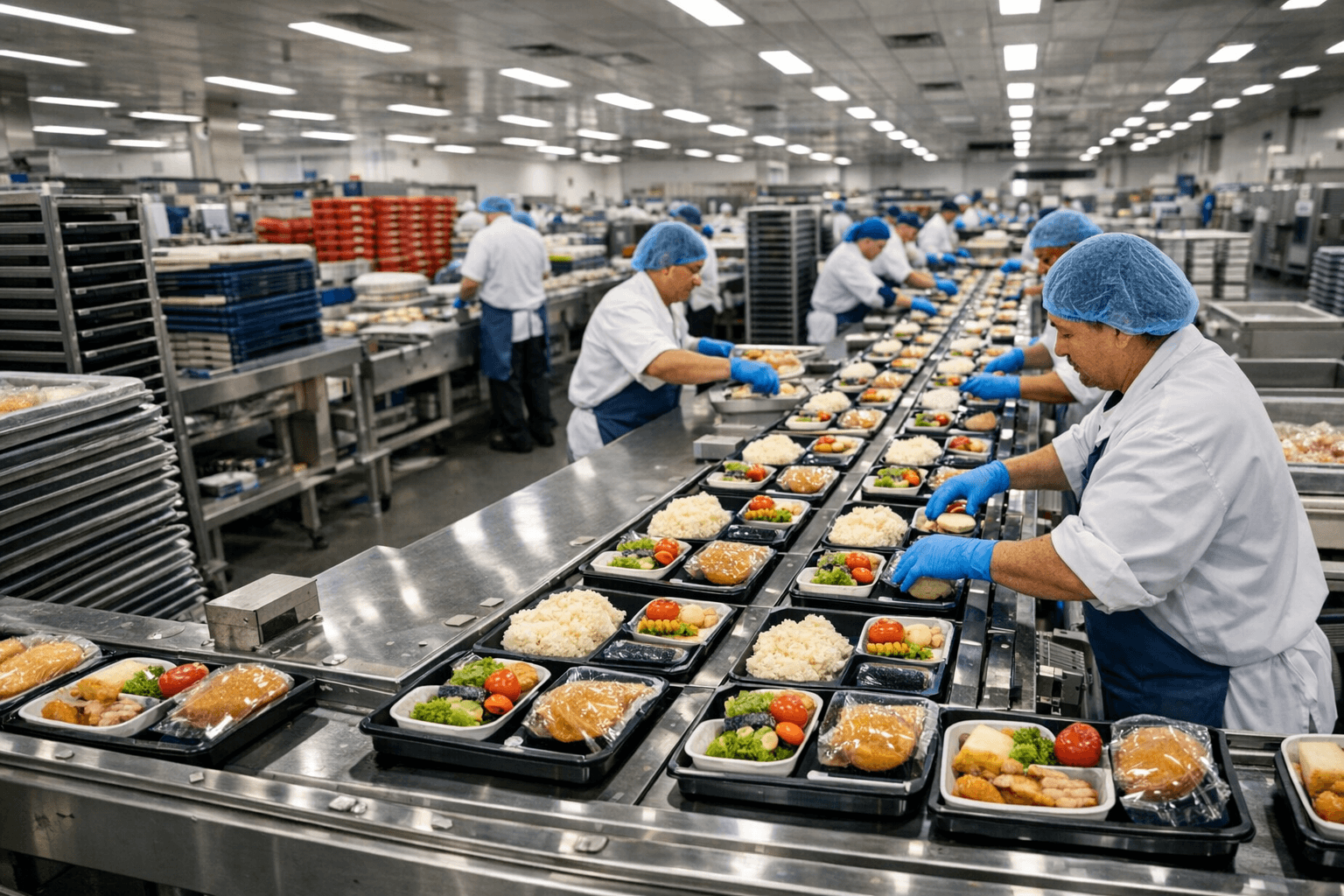
The multi-operator structure of airport food service adds another layer of difficulty. A single terminal may house eight to fifteen restaurant and quick-service concepts operated by three or four different concession management companies, each with their own corporate compliance requirements layered on top of the airport authority vendor standards. Airline catering facilities — the flight kitchens that prepare in-flight meals — operate airside with even stricter access controls and produce significantly higher oil volumes than terminal restaurants. These facilities at LAX alone can generate 500 to 1,000 gallons of used cooking oil per week across multiple flight kitchen operators. Coordinating grease pickup across this fragmented landscape requires a service provider who already holds security credentials at every major Southern California airport and understands the operational tempo of each facility.
The consequences of grease management failure at an airport extend far beyond a health department citation. An oil spill on a terminal loading dock can shut down a delivery access point for hours, affecting food supply chains for multiple restaurants during peak travel periods. A FOG violation that triggers a sewer backup in a terminal can close restrooms and food courts, creating a passenger experience crisis that makes regional news. Airport authorities in California also enforce their own vendor performance standards — repeated service failures can result in revocation of your vendor access badge, effectively ending your ability to operate at that airport. Our service eliminates these risks with security-cleared drivers who are already badged at LAX, SNA, SAN, and LGB, operating on TSA-coordinated schedules with full CDFA documentation that satisfies both state regulations and airport authority vendor compliance requirements.
4
SoCal airports actively served
99.8%
on-time pickup rate
120+
airport restaurant operators served
Security-Cleared Drivers Already Badged at Every Major SoCal Airport
The biggest barrier to airport grease service is security access. Airport authorities require vendor badge applications, background checks, vehicle inspections, and TSA-approved scheduling — a process that takes four to eight weeks for a new vendor at most airports. Our drivers already hold active security badges at LAX, John Wayne Airport (SNA), San Diego International (SAN), and Long Beach Airport (LGB). Vehicle placards, route approvals, and escort authorizations are current and maintained continuously. When you engage our service, there is no weeks-long credentialing delay — we are already cleared to operate in your terminal or flight kitchen facility. For a broader look at what to expect from professional grease pickup logistics, see our overview of grease pickup service (/blog/grease-pickup-service-what-to-expect).
- Active security badges held at LAX, SNA, SAN, and LGB
- TSA-compliant vehicle placards and approved routing at each airport
- No credentialing delay — service begins immediately upon agreement
- Badge renewals and background checks maintained proactively by our team
- Escort-ready for airside flight kitchen access when required
TSA-Coordinated Scheduling Around Terminal Operations
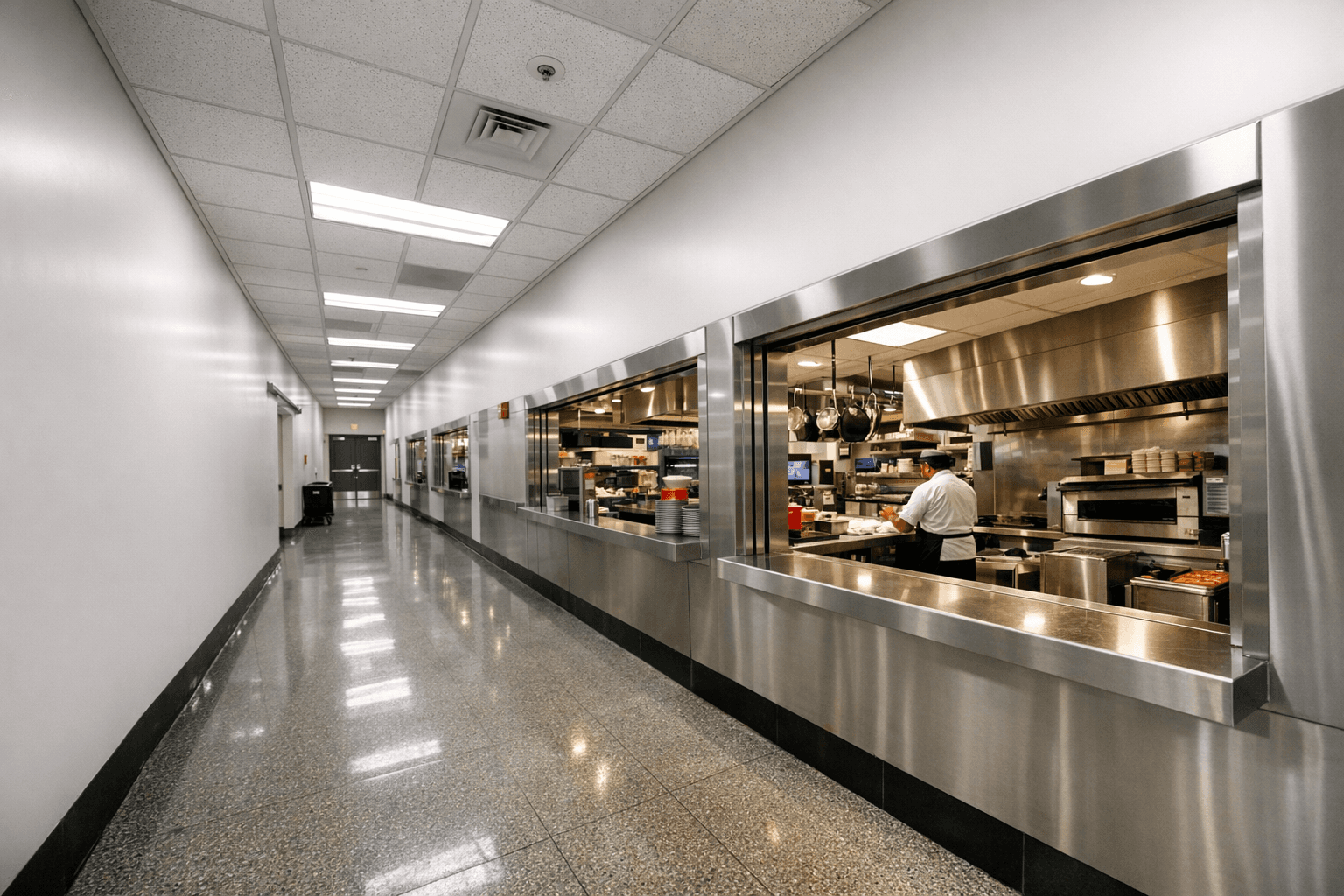
Airport loading docks and service corridors operate on schedules dictated by flight volumes, passenger flow patterns, and security sweep timing. A grease pickup that arrives during peak passenger boarding hours or conflicts with a TSA security operation will be turned away — and your container stays full until the next available window. Our scheduling is coordinated directly with airport operations and TSA requirements at each facility. Pickup windows are assigned during approved low-traffic periods, confirmed with terminal management in advance, and executed within the allotted time block. If a security event or flight disruption shifts the window, our dispatcher coordinates a same-day reschedule rather than skipping the pickup entirely.
- Pickup windows scheduled during TSA-approved low-traffic periods
- Pre-confirmed with terminal operations management before every visit
- Same-day rescheduling if security events shift the approved window
- Separate scheduling tracks for landside terminal and airside flight kitchen access
- Real-time coordination with airport dispatch for vehicle routing
Multi-Operator Terminal Coverage and Flight Kitchen Service
Airport terminals house multiple restaurant operators managed by different concession companies, and airline flight kitchens serve dozens of carriers from single facilities. Our service handles this fragmented structure with consolidated terminal coverage — we can service every restaurant in a terminal on a single visit, generating individual manifests for each operator, or we can service specific operators on separate schedules based on their corporate requirements. Flight kitchen service covers the high-volume facilities at LAX and SAN that produce 500 to 1,000 gallons per week, with container infrastructure and pickup frequency matched to continuous production schedules. For details on how bulk oil collection works at industrial volumes, see our bulk cooking oil disposal page (/services/bulk-cooking-oil-disposal-recycling).
- Consolidated terminal coverage — all restaurants serviced in one coordinated visit
- Individual CDFA manifests generated per operator for separate corporate compliance
- Flight kitchen service for facilities producing 500-1,000+ gallons per week
- Container infrastructure scaled from 100-gallon terminal units to 500-gallon flight kitchen tanks
- Single account coordinator for multi-terminal and multi-airport operators
Full CDFA Compliance and Airport Authority Vendor Documentation
Airport operators must satisfy both California state grease regulations and airport authority-specific vendor performance standards. The CDFA IKG program cdfa.ca.gov/ahfss/MPES/Rendering/ requires licensed transporters and CCR Title 3 Section 1180 compliant manifests for every pickup. Airport authorities layer additional documentation requirements including proof of insurance, vehicle inspection records, driver background verifications, and service performance reporting. Our online dashboard consolidates all of this — CDFA manifests, license credentials, insurance certificates, and service history — in a format that satisfies both state regulators and airport authority vendor compliance audits. For background on California grease hauler licensing verification, see our hauler licensing guide (/blog/grease-hauler-licensing-california-what-to-verify).
- CDFA-licensed drivers with credentials verified and stored in your dashboard
- Digital manifests auto-generated per CCR Title 3 Section 1180 after every pickup
- Airport authority vendor documentation including insurance and vehicle records
- Seven-year record retention satisfying both state and airport compliance audits
- Service performance reporting formatted for airport vendor review cycles
Airport Operations We Serve Across Southern California
Terminal Restaurant Operators
Full-service and quick-service restaurants inside airport terminals at LAX, SNA, SAN, and LGB producing daily fryer oil volume within secure terminal environments.
Airline Catering Flight Kitchens
High-volume airside flight kitchens preparing in-flight meals for domestic and international carriers, producing 500 to 1,000+ gallons of cooking oil per week.
Airport Concession Operators
Quick-service food courts, coffee shops with food programs, and grab-and-go concepts operating across multiple terminal locations under concession management agreements.
Concession Management Companies
Companies like HMS Host, SSP America, and OTG managing multiple restaurant brands across terminal portfolios with consolidated compliance and reporting needs.
Airport Lounge Kitchens
Airline and independent lounge kitchens preparing hot food service for premium passengers, with smaller but consistent oil volumes requiring documented disposal.
Ground-Side Airport Restaurants
Restaurants and food service operations in airport-adjacent hotels, rental car centers, and ground transportation facilities within airport authority jurisdiction.
Airport-Qualified Grease Service vs. Standard Commercial Haulers
Airport security clearance
TSA scheduling coordination
Multi-operator support
Flight kitchen capacity
Airport vendor compliance
Cost to operator
What's Included
Everything you need — nothing you don’t.
- Free collection containers sized for terminal restaurants or flight kitchen volume
- Scheduled pickup on TSA-coordinated windows with terminal operations confirmation
- CDFA-compliant digital manifest generated automatically after every pickup
- Online dashboard with compliance reports, airport vendor documentation, and pickup history
- Container cleaning, leak inspection, and service area cleanup on every visit
- Security-cleared drivers already badged at all four major SoCal airports
- 24/7 emergency overflow response coordinated through airport operations
- No contracts, no setup fees, no airport premium surcharges, no hidden costs
- Dedicated account manager familiar with airport vendor protocols
How It Works
Three steps. Five minutes. Done.
Request a Quote
Fill out a 30-second form or call us. No credit card, no commitment.
We Show Up On Time
Our uniformed driver arrives in a branded truck within your scheduled window. Every time.
Stay Compliant Automatically
Get digital manifests, pickup confirmations, and compliance records — all in your dashboard.
Frequently Asked Questions
Airport grease disposal is governed by multiple regulatory layers. At the state level, the CDFA Inedible Kitchen Grease program cdfa.ca.gov/ahfss/MPES/Rendering/ requires licensed transporters and compliant manifests per California Code of Regulations Title 3 Section 1180 for every pickup. California Health and Safety Code Section 114201 leginfo.legislature.ca.gov/faces/codes_displaySection.xhtml?lawCode=HSC§ionNum=114201 requires properly functioning grease traps and interceptors. Local FOG programs apply based on airport location — LAX falls under LA County Clean LA FOG requirements cleanla.lacounty.gov/fog/, John Wayne SNA under OC San FOG permit requirements ocsan.gov/ocsan-permits/businessfog/, and San Diego SAN under city FOG ordinances. Airport authorities add vendor-specific requirements including security credentialing, vehicle approvals, insurance minimums, and service performance standards that can exceed state and local requirements.
Our drivers hold active airport security badges issued by each airport authority following TSA-mandated background checks, fingerprinting, and security training. At LAX, badges are issued by Los Angeles World Airports under their vendor credentialing program. John Wayne Airport (SNA), San Diego International (SAN), and Long Beach Airport (LGB) each administer their own badge programs with similar requirements. Badge applications typically take four to eight weeks for new vendors, but our drivers already hold current badges at all four airports. Badges are renewed on the schedule required by each airport authority, and our operations team manages all renewals proactively so there is never a lapse in access. When you engage our service, there is no waiting period — we are cleared to service your facility from day one.
Yes. We routinely service every restaurant operator in a terminal during a single coordinated visit, which minimizes the number of security-cleared vehicle entries and reduces disruption to terminal operations. Each operator receives an individual CDFA manifest documenting their specific volume, pickup date, and facility address — so corporate compliance records are separated even though the physical collection happens in one pass. For concession management companies operating multiple brands across a terminal, we can also generate consolidated reports that roll up individual operator data into a portfolio view. This approach is common at LAX terminals where a single concession company may manage six to ten restaurant concepts. Read our guide on choosing a grease collection service (/blog/grease-collection-service-how-to-choose) for factors to evaluate when selecting an airport-qualified provider.
Terminal restaurants typically receive 50- to 150-gallon containers sized to their individual fryer output and the physical space available in terminal service corridors. Containers are positioned per airport authority guidelines for terminal service areas, which often specify location, containment requirements, and access restrictions. Airline catering flight kitchens operate at a completely different scale — these facilities can produce 500 to 1,000+ gallons of used cooking oil per week and require 300- to 500-gallon tanks or holding infrastructure with scheduled pump-outs. We provide all equipment at no cost, sized to your specific operation, and replace containers free of charge when needed. For details on our full equipment program, visit our equipment page (/services/equipment). All containers meet CDFA IKG program requirements for secure cooking oil storage.
Airport grease emergencies require coordination through airport operations dispatch in addition to standard emergency response. When you call our 24/7 emergency line, our dispatcher contacts airport operations simultaneously to clear security access and vehicle routing for the emergency vehicle. Response time averages four hours, though airport security protocols can add time depending on the current threat level and terminal activity. The driver arrives through the approved emergency access route, pumps the container, cleans any overflow from the service area, and files an incident report that satisfies both our service standards and airport authority incident documentation requirements. After the emergency, we review your pickup frequency and container size to prevent recurrence — because a grease overflow in an airport terminal is an operational disruption that affects far more than just your restaurant.
Yes. Our drivers hold security credentials that cover both the Tom Bradley International Terminal (TBIT) and all domestic terminals at LAX. International terminal operations have additional customs and border protection considerations that affect vehicle routing and timing, and our scheduling accounts for these constraints. We also service the LAX Midfield Satellite Concourse and any new terminal facilities as they come online. Pickup windows are coordinated separately for each terminal based on that terminal specific operations schedule and security requirements. For operators managing restaurants across multiple LAX terminals, our single account coordinator and consolidated dashboard provide unified visibility across all locations. The same coverage model applies to our service at SNA, SAN, and LGB.
What Our Clients Say
“We operate seven restaurant concepts across three LAX terminals. Getting a grease hauler badged at LAX used to take two months and then they would still miss pickups because they could not navigate the security protocols. This team was already cleared at every terminal when we signed on. Individual manifests for each restaurant, one dashboard for my whole portfolio, and zero missed pickups in sixteen months.”

Robert Nakamura
Regional Operations Director, Pacific Terminal Dining Group
Los Angeles
“John Wayne Airport has strict vendor standards and our old hauler kept getting turned away at the security checkpoint because their paperwork lapsed. We switched and have not had a single access issue. The driver knows the terminal, knows the schedule, and the whole thing runs on autopilot. I barely think about grease anymore.”

Diana Gutierrez
Facilities Manager, SNA Airport Concessions
Santa Ana
“Our flight kitchen at SAN produces 700 gallons a week during peak travel season. We needed a hauler who could handle volume, get through airside security, and hit a tight service window between flight prep cycles. They have not missed a window in over a year, and the manifests are in our compliance portal before I finish my morning coffee.”

James Okafor
Flight Kitchen General Manager, Pacific Coast Airline Catering
San Diego
Related Resources
Guides
Free Tools
- Grease Trap Calculator
Find your recommended pumping frequency
- Compliance Checker
Check if you meet California grease requirements
Related Solutions
Stadium & Arena Grease Pickup
High-volume event-day grease collection for stadiums, arenas, and entertainment venues with multi-stand coordination and post-event surge capacity.
Learn moreFood Processor Oil Collection
Industrial-scale bulk cooking oil collection for food manufacturing facilities producing 1,000 to 5,000+ gallons per week with holding tank infrastructure.
Learn moreCatering Company Grease Pickup
Flexible oil collection for catering operations with variable event schedules, commissary kitchen compliance, and seasonal volume adjustments.
Learn moreGet Free Airport Grease Pickup — Security-Cleared and Ready
Tell us about your airport operation and we will confirm service with our already-credentialed team. No badge wait time — service begins within the week.