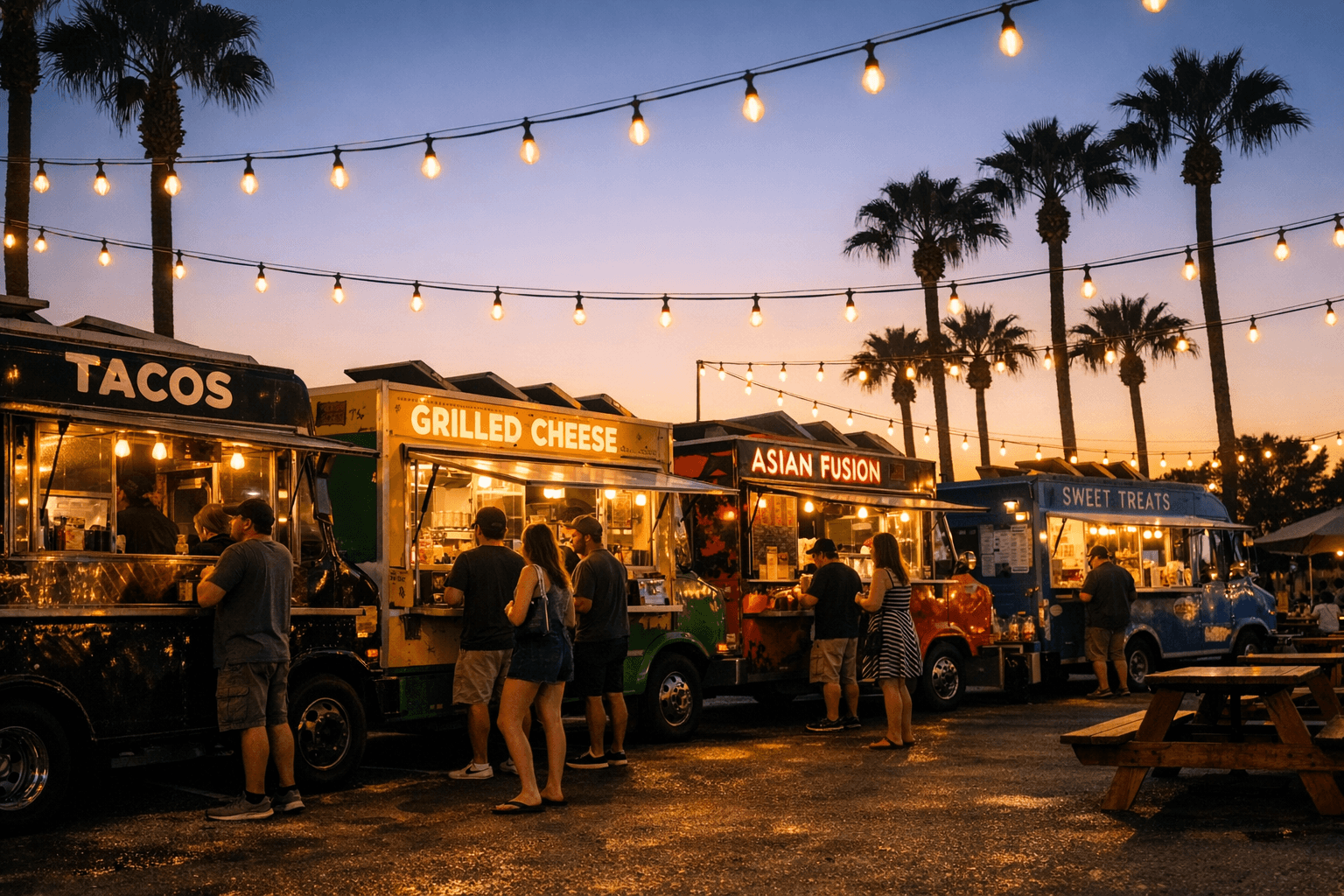
Grease Pickup That Moves With Your Food Truck
Free, flexible cooking oil collection for food trucks, mobile kitchens, and event vendors across Southern California. We service your commissary kitchen, meet you at regular lots, and handle event-day volume spikes — so you spend less time dealing with grease and more time serving customers.
Grease Pickup That Moves With Your Food Truck
Free, flexible cooking oil collection for food trucks, mobile kitchens, and event vendors across Southern California. We service your commissary kitchen, meet you at regular lots, and handle event-day volume spikes — so you spend less time dealing with grease and more time serving customers.
Quick Answer
Food truck grease pickup is a free service that collects used cooking oil from mobile kitchen operations at commissary kitchens, regular lot locations, or event sites. A CDFA-licensed driver arrives on a scheduled basis, pumps out your compact collection container, generates a digital manifest, and transports oil for biodiesel recycling. Service covers Orange County, Los Angeles, and San Diego.
Food Trucks Generate Restaurant-Level Grease With None of the Infrastructure
A busy food truck frying tacos, chicken, or funnel cakes at the OC Fair can produce 30 to 50 gallons of used cooking oil in a single weekend — the same volume a small sit-down restaurant generates in a week. But unlike a restaurant, you have no permanent container out back, no dedicated loading dock, and no fixed address for a hauler to visit. Most grease haulers will not service food trucks at all because the logistics do not fit their route model. That leaves you driving used oil back to your commissary kitchen in open containers, hoping nothing spills in transit, and trying to dispose of it during your limited commissary hours. California Health and Safety Code Section 114201 requires proper grease trap maintenance for all food facilities, and county FOG programs treat mobile food operations with the same compliance expectations as brick-and-mortar restaurants leginfo.legislature.ca.gov. For a full breakdown of how FOG violations affect mobile operators, see /blog/california-fog-violations-penalties-restaurants.
The commissary kitchen adds its own layer of complexity. Most food truck operators in Southern California are required to operate out of a licensed commissary, and many commissaries impose their own grease disposal rules — including requirements for CDFA-compliant manifests and clean container areas. If your commissary shares a grease container with other trucks and vendors, you are at the mercy of whoever fills it fastest. An overflow at the commissary does not just affect you — it can trigger violations for the entire facility, jeopardize your commissary agreement, and leave you scrambling for a new base of operations. The LA County 25-percent grease trap rule applies to commissary kitchens as well, and our guide at /blog/la-county-25-percent-grease-trap-rule explains what commissary operators measure and how to stay compliant.
Event-based volume spikes make scheduling even harder. You might produce minimal oil during a quiet weekday lot shift and then generate a week of volume during a three-day street food festival. Generic haulers cannot handle that variability — they offer fixed weekly schedules designed for stationary restaurants. Food truck operators deserve a grease partner that understands mobile operations, adapts to your actual production patterns, and meets you where you are — whether that is your commissary in Santa Ana, your regular Tuesday lot in Costa Mesa, or the vendor staging area at a San Diego food festival. Use our /tools/compliance-checker to verify that your current disposal setup meets California requirements for mobile food operations.
520+
food trucks and mobile vendors served
99.2%
on-time pickup rate
48 hr
event scheduling turnaround
Commissary Kitchen Pickup — Your Home Base Covered
Most food truck operators start and end their day at a commissary kitchen, and that is where the bulk of your oil disposal happens. We service commissary kitchens across Orange County, Los Angeles, and San Diego with the same reliability we bring to standalone restaurants. Your container lives at the commissary, our driver arrives on a fixed schedule, and your oil is collected before it becomes anyone else is problem. If your commissary shares a container with other vendors, we track volume per operator so you have documentation for your commissary agreement and for any CDFA manifest requirements.
- Fixed pickup schedule at your commissary kitchen — same day, same driver
- Per-operator volume tracking for shared commissary containers
- Coordination with commissary management on access and scheduling
- Container sized for your individual volume or shared facility output
- Pickup schedule adjusts automatically as your production changes seasonally
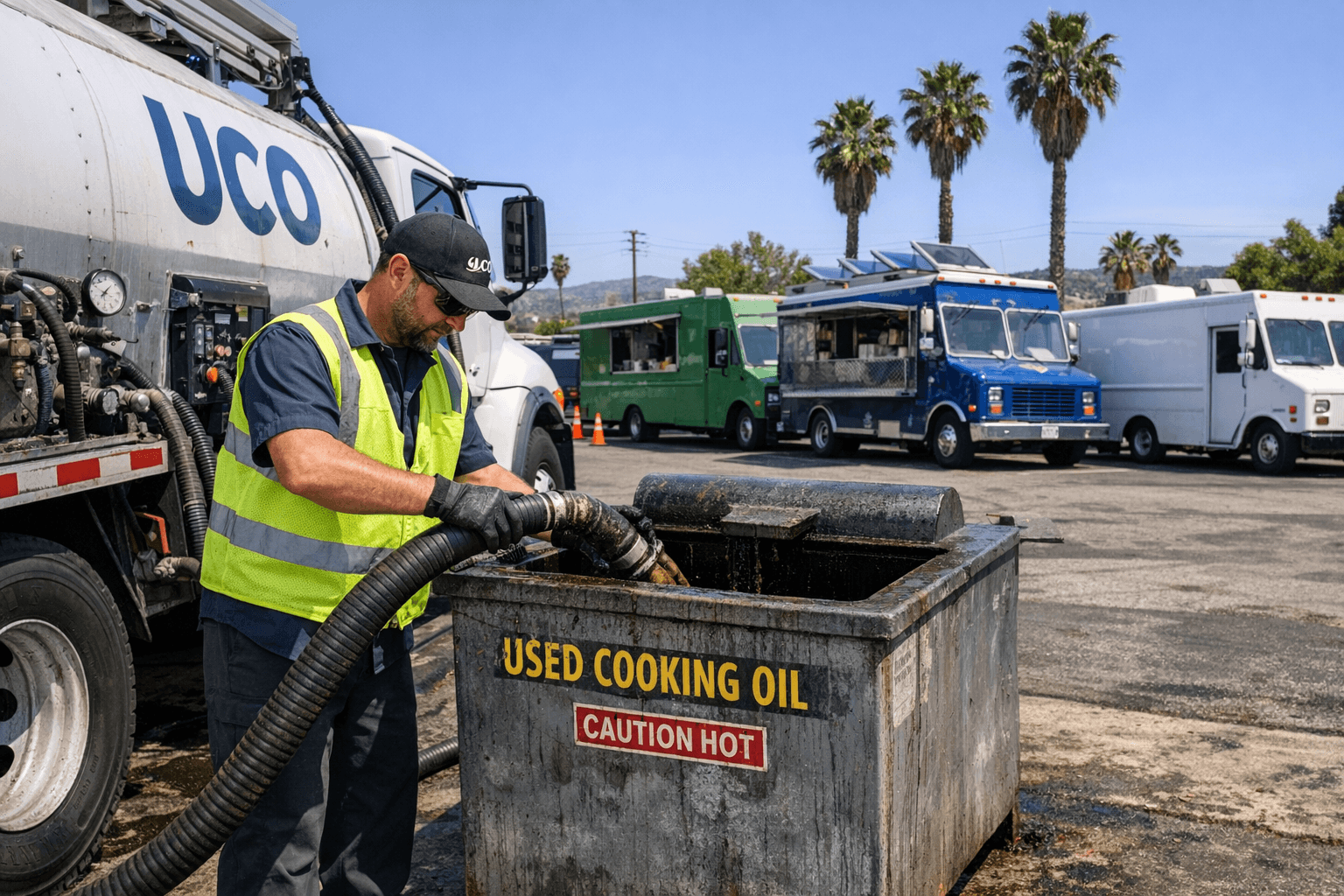
Event-Day and Festival Grease Service
The OC Fair, 626 Night Market, SoCal food truck festivals, and weekend lot events can spike your oil output by three to five times your normal volume. We offer 48-hour event scheduling — tell us where you will be and your expected production, and we coordinate a pickup at the event site or arrange for an extra commissary run immediately after. No more transporting open containers of hot oil across town after a twelve-hour service day. For operators who run regular weekly events, we build the event schedule into your standard pickup rotation.
- Event-site pickups coordinated 48 hours in advance
- On-site service at major SoCal festivals and food truck gatherings
- Post-event commissary runs for operators who transport oil back to base
- Recurring event schedules integrated into your standard pickup rotation
- Emergency same-day service available for unexpected volume spikes
Compact Equipment for Mobile Operations
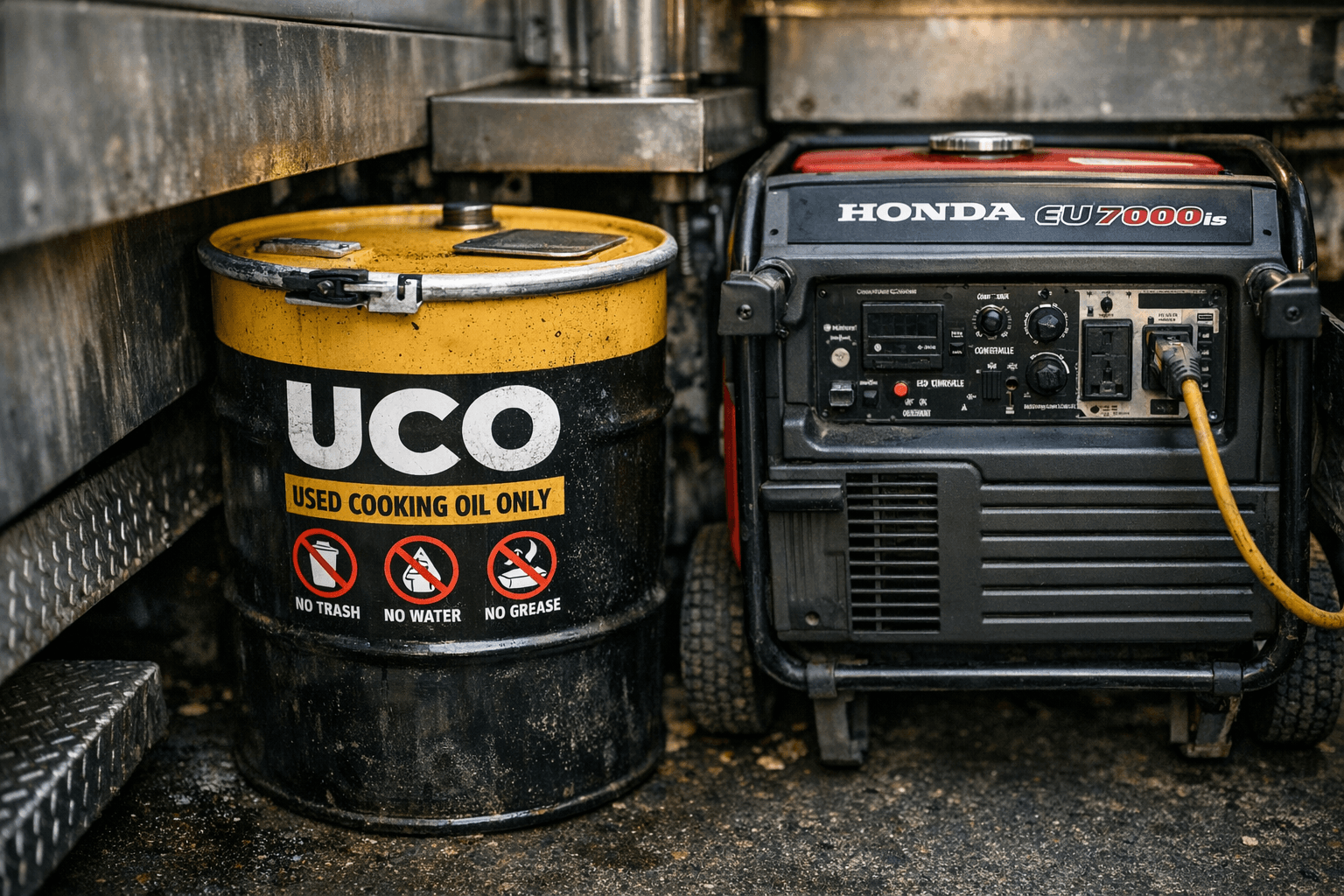
Food trucks do not have space for a 300-gallon container behind the building. We provide compact 20-gallon to 65-gallon containers designed for commissary staging areas, truck storage compartments, and tight lot setups. Locking lids prevent contamination and spills during storage, and the containers are sized to fit the footprint your commissary assigns you. For operators who prefer to use their own containment, we service any food-grade container that meets CDFA IKG program requirements. All equipment is free — no rental, no deposit, no maintenance fees.
- Container sizes from 20 to 65 gallons designed for mobile operation footprints
- Locking lids prevent contamination, spills, and unauthorized dumping
- Fits commissary staging areas, truck storage bays, and lot setups
- Free delivery, placement, maintenance, and replacement
- We also service your existing food-grade containers if you prefer
Full CDFA and FOG Compliance Without the Paperwork
California does not give food trucks a pass on grease regulations. The CDFA IKG program under CCR Title 3 Section 1180 requires licensed transporters and compliant manifests for every pickup — whether the oil originates from a restaurant on Main Street or a food truck at a Saturday market. LA County FOG requirements cleanla.lacounty.gov/fog/ and OC San permits ocsan.gov apply to commissary kitchens, and your commissary operator may require you to provide individual manifest documentation as a condition of your lease. We handle all of this automatically, and our /services/grease-trap-cleaning program covers commissary trap maintenance for facilities that need it.
- CDFA-licensed drivers with credentials verified on every route
- Digital manifests auto-generated per CCR Title 3 Section 1180 after every pickup
- Documentation satisfies commissary lease requirements and FOG program audits
- Seven-year record retention accessible through your online dashboard
- One-click compliance reports ready for health inspectors or commissary management
Mobile Food Operations We Serve Across Southern California
Food Trucks & Lunch Trucks
Full-service food trucks with onboard fryers producing consistent daily oil volume from tacos, fried chicken, fries, and other fried menu items across regular lot locations.
Festival & Event Vendors
Mobile vendors working SoCal festivals, fairs, night markets, and pop-up events with high-volume, short-duration frying that creates massive oil spikes over two to four day periods.
Commissary Kitchen Operators
Licensed commissary facilities hosting multiple food truck tenants who need coordinated grease collection, shared container management, and per-operator documentation.
Mobile Catering Units
Catering trucks and mobile kitchen trailers that serve corporate events, weddings, and private functions with variable oil production depending on menu and event size.
Breakfast & Coffee Trucks
Morning-service mobile kitchens producing moderate oil volumes from hash browns, donuts, and fried breakfast items that still require CDFA-compliant disposal documentation.
Pop-Up Kitchen Operators
Temporary and rotating kitchen installations at breweries, retail locations, and parking lots that need flexible pickup scheduling without long-term commitments.
Mobile-Ready Grease Service vs. Standard Restaurant Haulers
Mobile operation support
Cost to operator
Container sizing
Event scheduling
CDFA compliance
Volume flexibility
What's Included
Everything you need — nothing you don’t.
- Free compact collection container sized for your commissary or mobile footprint
- Scheduled pickup at your commissary kitchen on a consistent fixed day
- CDFA-compliant digital manifest generated automatically after every pickup
- Online dashboard with pickup history, compliance reports, and volume tracking
- Event-day and festival pickup scheduling with 48-hour turnaround
- Email and text confirmation after each completed pickup
- 24/7 emergency overflow response at no additional charge
- No contracts, no setup fees, no monthly charges, no hidden costs
- Dedicated account manager with flexible mobile scheduling
How It Works
Three steps. Five minutes. Done.
Request a Quote
Fill out a 30-second form or call us. No credit card, no commitment.
We Show Up On Time
Our uniformed driver arrives in a branded truck within your scheduled window. Every time.
Stay Compliant Automatically
Get digital manifests, pickup confirmations, and compliance records — all in your dashboard.
Frequently Asked Questions
Food trucks in California are subject to the same grease disposal regulations as brick-and-mortar restaurants. The CDFA Inedible Kitchen Grease program cdfa.ca.gov/ahfss/MPES/Rendering/ requires licensed transporters and compliant manifests per CCR Title 3 Section 1180 for every used cooking oil pickup. California Health and Safety Code Section 114201 leginfo.legislature.ca.gov/faces/codes_displaySection.xhtml?lawCode=HSC§ionNum=114201 requires proper grease trap maintenance for all food facilities, including mobile operations. At the county level, your commissary kitchen must comply with LA County FOG cleanla.lacounty.gov/fog/ or OC San FOG permit requirements ocsan.gov/ocsan-permits/businessfog/ depending on location. Violations start at $1,000 per offense regardless of whether the oil originated from a truck or a restaurant.
Yes. We offer event-site and lot-location pickups in addition to standard commissary service. Provide us with 48 hours notice including the event address, your expected oil volume, and your preferred pickup window, and we coordinate a driver to meet you on site. For operators who work regular weekly lots — such as a Tuesday lunch spot in Irvine or a Friday night location in Long Beach — we integrate those locations into your standard pickup rotation. On-site pickups generate the same CDFA-compliant manifests as commissary pickups, so your documentation is consistent regardless of where the oil was collected.
Most commissary kitchens in LA County and Orange County are required to hold a FOG permit because they are classified as food service establishments generating fats, oils, and grease. In LA County, the FOG program cleanla.lacounty.gov/fog/ requires interceptor maintenance, cleaning logs, and disposal documentation. In Orange County, OC San ocsan.gov/ocsan-permits/businessfog/ administers a separate permit with inspection requirements. As a food truck tenant, you may be required by your commissary lease to provide proof of CDFA-compliant grease disposal, maintain individual manifests, and contribute to the shared grease infrastructure compliance. Our per-operator tracking and tenant-level documentation satisfy these lease requirements.
A food truck with one or two fryers running a standard lunch or dinner service typically produces 15 to 30 gallons of used cooking oil per week. Heavy frying operations — fried chicken, fish and chips, funnel cakes, churros — can produce 40 to 60 gallons per week. Event days spike output dramatically: a three-day festival can generate 30 to 50 gallons from a single truck. We size your container and pickup frequency based on your actual production rather than industry averages.
We provide containers from 20 gallons to 65 gallons for food truck and mobile kitchen operators — significantly smaller than the 100-to-300-gallon containers used by restaurants. The most common size for a single food truck at a commissary is 35 gallons, which handles one to two weeks of output for a standard frying operation. For commissary kitchens hosting multiple trucks, we provide shared containers up to 150 gallons with per-operator volume tracking. All containers include locking lids to prevent contamination and unauthorized dumping. Equipment is provided, maintained, and replaced at no cost.
Contact us and we relocate your container to the new commissary within five business days at no charge. If you are adding a lot location rather than switching commissaries, we add that location to your pickup rotation — our driver will service both your commissary and your regular lot on a schedule that matches your production at each site. We coordinate with both the old and new commissary management to ensure there is no gap in service during the transition. All historical compliance records transfer automatically to your updated account.
What Our Clients Say
“I run two fryers six days a week and my commissary was threatening to drop me because I kept overfilling the shared container. Now I have my own 35-gallon bin at the commissary, it gets picked up every Monday and Thursday, and I have manifests that prove I am handling my oil properly. My commissary owner actually thanked me for switching.”

Miguel Torres
Owner & Operator, El Fuego Taco Truck
Santa Ana
“We work the 626 Night Market, OC Night Market, and three regular weekly lots. The event scheduling is a game changer — I text them our weekend schedule on Wednesday and there is a driver waiting at the commissary Monday morning to grab everything. No more driving open containers of oil back from events at midnight.”

Sarah Kim
Co-Owner, Seoul Street Kitchen
Irvine
“I manage a commissary with fourteen food truck tenants and the grease situation was a disaster before we switched. Now every truck has trackable documentation, the shared container never overflows, and my FOG permit inspections have been clean three cycles running. The per-operator reports made it easy to hold tenants accountable.”

James Whitfield
Operations Manager, Bay City Commissary
San Diego
Related Resources
Guides
Free Tools
- Grease Trap Calculator
Find your recommended pumping frequency
- Compliance Checker
Check if you meet California grease requirements
Related Solutions
Ghost Kitchen Grease Pickup
Multi-tenant grease collection for cloud kitchens and shared commissary spaces with per-tenant documentation and facility-level compliance management.
Learn moreRestaurant Grease Pickup
Free, scheduled cooking oil collection for independent restaurants with CDFA-compliant manifests and reliable weekly service across Southern California.
Learn moreStadium & Arena Grease Pickup
High-volume grease collection for stadiums, arenas, and event venues with event-day surge scheduling and multi-concession coordination.
Learn moreGet Free Food Truck Grease Pickup — No Contract Required
Tell us about your truck, commissary location, and regular schedule. We will confirm your pickup plan within 2 hours. Container delivery is free.